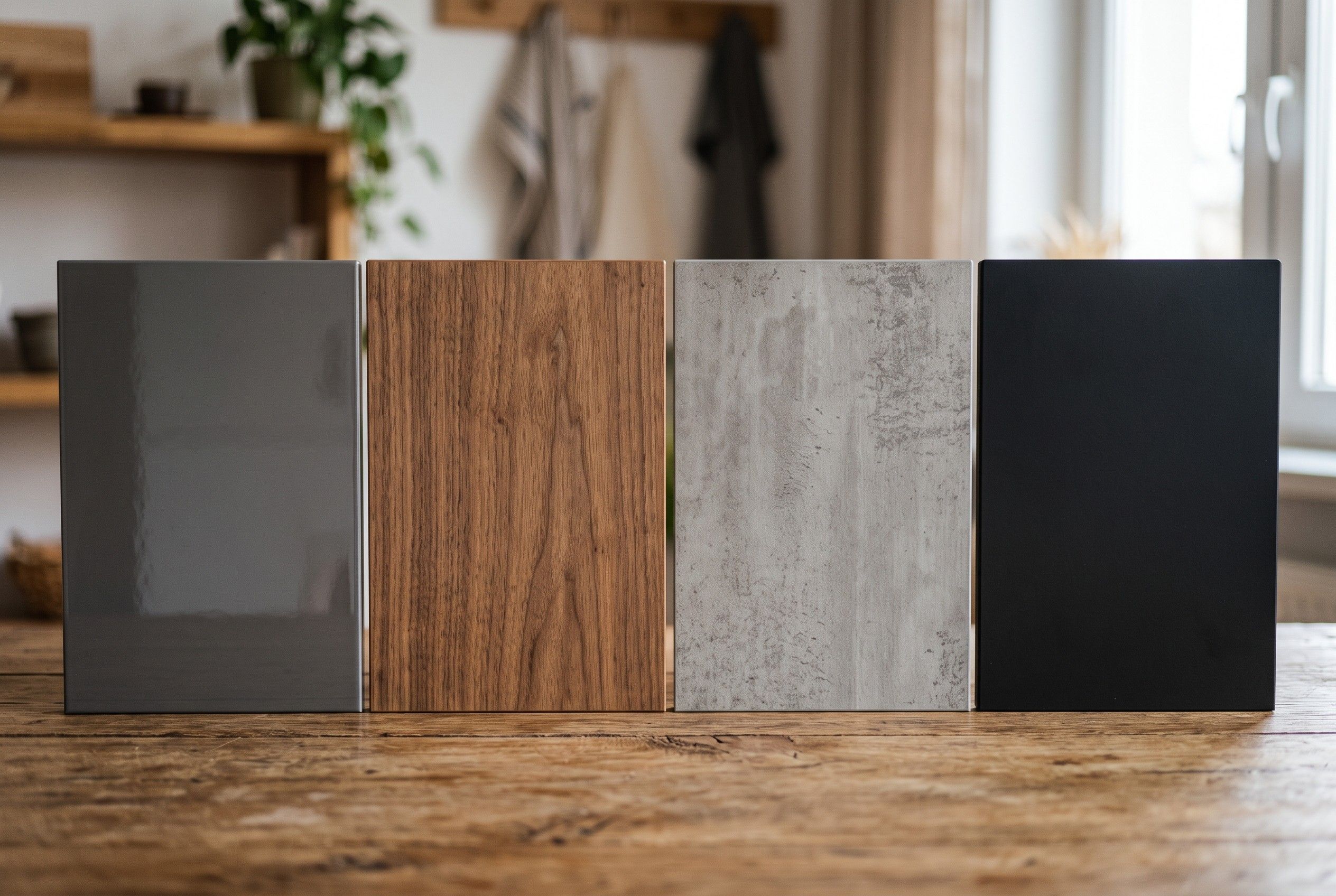
Kitchens and made-to-measure wardrobes most often have one of four types of front: lacquer, veneer, laminate or Fenix. They look different at first glance, but what matters more is how they cope with daily use: fingerprints, an accidental scrape with a knife, damp near the sink. Laminate wins on surface durability and price, veneer on the natural grain of wood, Fenix on its matt feel and the way heat removes fine scratches, and lacquer on freedom of colour and sheen. Many kitchens combine several of them.
Lacquered fronts
The base is MDF board, either flat or routed. The front is sanded and primed, then sprayed with several coats of lacquer in a spray booth, most often polyurethane or UV-cured. You choose the sheen level independently of the colour: matt, satin, semi-gloss or full gloss. Gloss is the most demanding to keep looking good, since it shows fingerprints and fine scratches the most. Routing MDF allows for framed fronts and profiles the other technologies cannot match, which makes lacquer a natural choice for classic and transitional styles.
Lacquer is hard, but like any coating it can scratch, particularly in gloss. Light, surface scratches can be polished out with a specialist paste; a cut through the lacquer layer itself needs a repair at the lacquering shop or a new front. Cleaning is limited to a soft microfibre cloth and a mild detergent, no scouring pads or harsh cleaners, which dull the surface over time.
The edges of a lacquered front are routed and finished with the same coat as the face, so you see no seam between the face and the side. Laminate fronts have glued-on edge banding instead. If the colour eventually feels dated, some lacquering shops will respray existing fronts. That can work out cheaper than replacing the whole run, though it means taking the fronts off and transporting them to the workshop.
Veneer fronts
Veneer is a thin sheet of real wood, most often oak, ash, American walnut or maple, glued to a base board of MDF or chipboard and sealed with lacquer or oil. The result sits close to solid wood, but the front is lighter and less prone to warping with humidity, since the base board stabilises the wood's movement. Every sheet of veneer has its own grain pattern, so even fronts from the same batch vary slightly. On a large wall that is an advantage, but it can be a problem if you expect a completely uniform colour.
An oiled finish brings out the wood's natural texture and allows local repairs to worn patches by re-oiling, but it needs refreshing from time to time, particularly on the most-used fronts. Lacquer on veneer resists moisture and scratches better, at the cost of slightly less scope for a local touch-up. Veneer costs more than laminate and usually more than lacquer, since the price of the base board is joined by the cost of the timber itself, which varies by species.
The species changes the price, and it changes the character of the whole room just as much. Oak has a bold, coarse grain and suits both classic and contemporary kitchens. Ash is lighter and more even, American walnut is usually the darkest and most expensive, associated with formal interiors. Direct, sustained sunlight changes the shade of wood faster than lacquer or laminate. A front by a window can end up a slightly different colour from one deeper in the room after a few years.
Laminate fronts
A laminate front is chipboard or MDF faced with a decorative layer, either melamine or high-pressure laminate (HPL), with the visible edges finished in banding, usually ABS colour-matched to the decor. Of the four materials, this is the most resistant to scratches and surface wear, since its dense, pressed structure does not absorb moisture and stands up to detergents without dulling. The range of decors is the widest of the four, from solid colours through wood-effect textures to patterns that mimic concrete or stone.
Laminate's weak point is not the surface but the edge. The banding is glued on separately and, after years of contact with steam and heat near a dishwasher, can start to lift at the corners. The surface itself cannot be repaired locally: a scratch or a chip means replacing the whole front, not a touch-up. It is the cheapest of the four materials and the most predictable to maintain.
Within laminate itself there are grades. Standard low-pressure melamine is the cheapest option. Thicker, denser high-pressure laminate is the choice where extra resistance to moisture and knocks matters, for instance on bathroom cabinet fronts or in a utility room. Synchronised-pore finishes, where the surface texture lines up with the printed pattern, make laminate resemble wood by touch as well as by sight.
Fenix fronts
Fenix NTM is a newer-generation material made using nanotechnology, with a very matt, velvety surface that does not show fingerprints and barely reflects light. It resists water and household cleaning products, and fine surface scratches can be removed with heat, following the manufacturer's instructions, since the material can thermally heal these micro-marks. That does not extend to deeper scratches or mechanical damage, only the thin layer of micro-marking that everyday use leaves behind.
Fenix tends to go into minimalist kitchens, where a uniform, matt plane without gloss or visible wear marks is the point. It is priced for each project and colour, usually close to or above the upper end of veneer. It suits people who see the fronts as the most important part of the kitchen budget.
Beyond kitchen fronts, Fenix also turns up on worktops and in office furniture, wherever scratch resistance matters alongside a soft, warm feel. Its matt, uniform surface pairs well with handleless, push-to-open fronts, since nothing interrupts the smooth plane of the cabinet.
Which front for which cabinet
| Front | Scratch resistance | Fingerprints | Repairing light scratches | Indicative price per m², 2026 |
|---|---|---|---|---|
| Lacquer | medium to high, depending on sheen | visible, especially in gloss | polishing paste; deeper scratches need a lacquering shop | from approx. PLN 270 (matt) |
| Veneer | medium, depending on species and finish | rarely visible | oil: local touch-up; lacquer: harder | PLN 450–1,800, depending on species |
| Laminate | high on the surface, the edge banding is the weak point | almost invisible on textured finishes | no local repair, front replacement | from approx. PLN 150 (2025) |
| Fenix NTM | high, fine scratches removable with heat | none, anti-fingerprint surface | thermal self-healing of micro-marks | priced individually, usually close to the upper end of veneer |
Fronts do not have to match across the whole project. A common approach is lacquer or laminate on the fronts used every day, with veneer or Fenix on the island or a display cabinet that draws the eye most. Near the dishwasher and the sink, it is worth choosing the material least sensitive to moisture, laminate or a good-quality lacquer, and keeping veneer away from sources of steam. We look at how these decisions affect the price of a whole project in the article on made-to-measure furniture prices. Matching hardware to particular fronts is covered in the article on hardware brands.
If you can’t decide between materials, compare samples in daylight at home, not on a screen. Matt, gloss and veneer grain all look different in daylight than on a visualisation. Send us the dimensions and your initial preferences through the quote form, and we’ll quote for the materials you’ve chosen.
Everyday care
- Lacquer and Fenix: a soft microfibre cloth, a mild washing-up liquid, no scouring pads or scouring powders.
- Oiled veneer: local re-oiling where the finish has worn, and avoid standing water on the surface.
- Lacquered veneer: care as for lacquer, plus protection from prolonged direct sun, so the wood does not change shade unevenly.
- Laminate: most household cleaners are safe; check the edge banding once a year, especially near the dishwasher.
- All fronts: don’t prise them open with a knife, and put a hot pan on a trivet, never directly against a cabinet front.
When you choose, start with the cabinets you use most. Keep the materials that are mainly there to look good for places that see less wear.