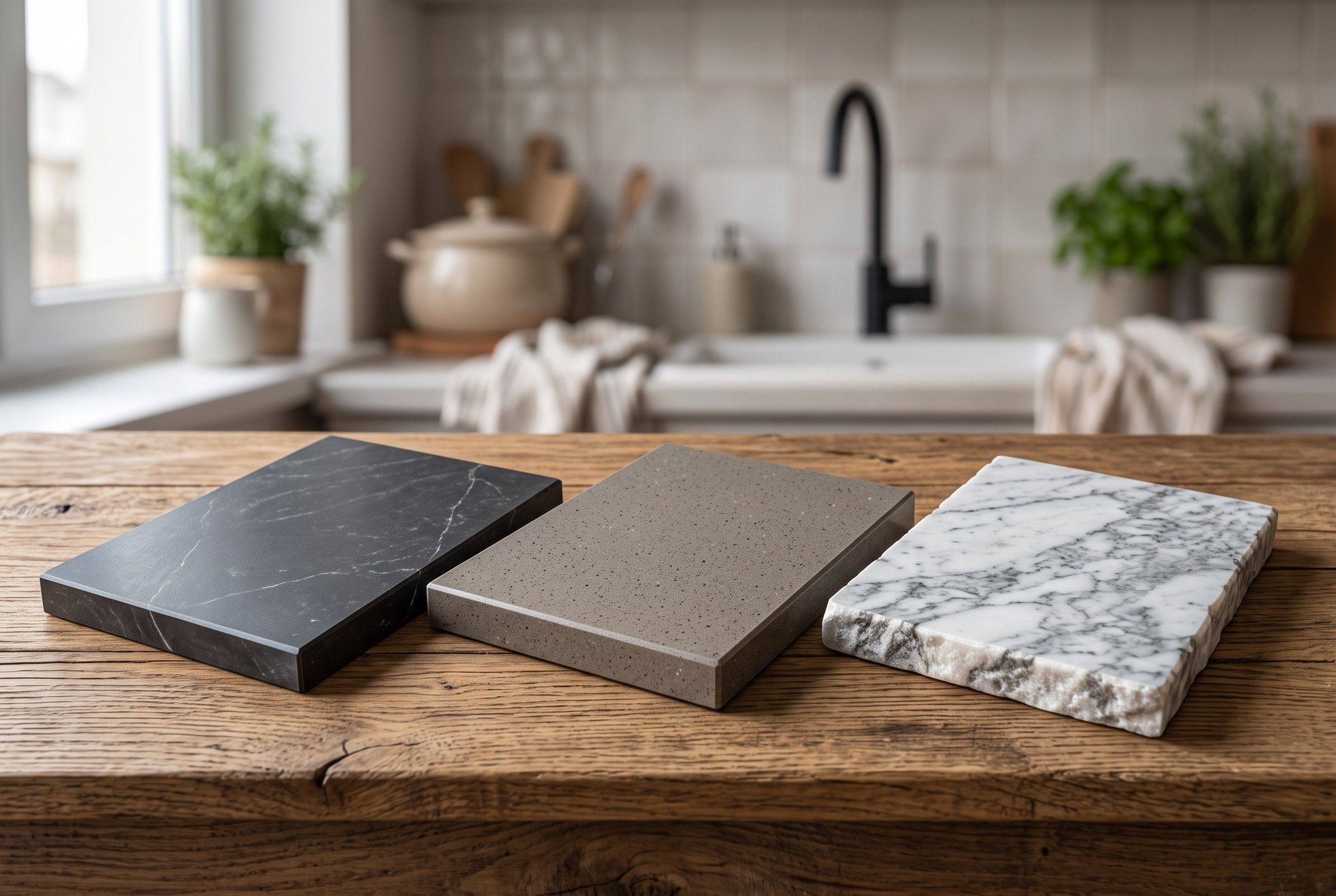
Sintered stone, engineered quartz and natural stone look similar on a visualisation, but the difference shows up on a Wednesday evening: a hot pan straight off the gas, a knife with no board under it, spilled lemon juice. Sintered stone shrugs off all of that best, engineered quartz needs a trivet under hot pans, and natural stone, marble especially, needs regular sealing and care around acids. Prices follow a similar order, though at the top end granite and quartzite can cost more than sintered stone.
Sintered stone: composition and properties
Sintered stone, sold under trade names such as Dekton or Neolith, is a blend of quartz, feldspar, clay and ceramic pigments. It is pressed under very high pressure and fired at around 1,100 to 1,300°C. The result has a structure close to a large-format ceramic tile: practically zero porosity and high hardness. Water, wine or oil do not soak into the surface, so everyday cleaning is a wipe with a damp cloth, with no sealing needed.
Sintered stone’s biggest strength is its resistance to heat of up to 300–400°C and to thermal shock. A hot pan straight from the burner or a tray out of the oven leaves no mark, which you can’t say of engineered quartz. The flip side of that hardness is brittleness, close to technical ceramic. Sintered stone copes well with scratches, but less well with a sharp knock to an edge or corner, which can chip it. That matters most during transport and fitting.
Good-quality sintered stone is coloured through the full thickness of the slab. A polished cut-out for a sink or a small chip does not expose a paler core underneath. That sets it apart from cheaper materials, where the colour is really just a thin surface layer.
Engineered quartz: composition and properties
Engineered quartz is ground quartz, usually 90–94% by content, bound with polyester resin and pigments, pressed under high pressure into a uniform slab. The resin makes the material less brittle than sintered stone and easier to cut, so repairs around sink and hob cut-outs are less often visible.
That same resin is the weak point at high temperature. Engineered quartz loses its resistance above roughly 100–130°C, so always put a hot pan or pot on a trivet. The material is also not well suited to outdoor use, since prolonged sun can fade the colour over time. In exchange, engineered quartz weighs roughly a fifth less than natural stone of the same thickness, which makes it easier to transport and install, especially in large, single-piece slabs.
The pattern in engineered quartz is designed and repeatable, so successive slabs from the same range look almost identical. That is an advantage for a large kitchen island made of several pieces, since the joins are less noticeable than when matching two different pieces of natural stone. For the same reason, engineered quartz is often the first choice if you are planning to extend an existing worktop in future, for instance when reworking an island.
Natural stone: granite, marble, quartzite
Granite is the natural stone most often chosen for worktops, with a porosity of around 0.5–1.5%, hard and scratch-resistant. Natural quartzite has even lower porosity, 0.1–0.7%, and copes far better with acids, lemon juice or vinegar for instance, which leave permanent, dull marks on marble. Marble is the most porous of the three and the most demanding to maintain, but it is also often held up as the classic decorative stone for its distinctive veining.
Every slab of natural stone has its own pattern of veins and markings, because it is quarried rather than manufactured. Two worktops cut from the same block will still differ slightly. Granite and quartzite need sealing roughly every one to two years; marble more often. A simple home test is to pour water on the surface: if the drops soak in quickly instead of beading, it is time to reseal.
You also choose natural stone differently from the other two materials. Usually you or your designer look at the actual slabs at a stone merchant’s and mark the sections for the most visible places, such as an island. On larger projects, it is worth asking whether neighbouring pieces can be cut from the same slab, so the veining runs through fairly continuously rather than breaking at the join.
Heat and stain resistance in practice
| Material | Resistance to high heat | Porosity and staining | Sealing |
|---|---|---|---|
| Sintered stone | very high, up to 300–400°C, resists thermal shock | practically zero porosity | not required |
| Engineered quartz | limited, up to approx. 100–130°C, trivets recommended | very low porosity | not required |
| Granite | high | low, 0.5–1.5% | yes, every 1–2 years |
| Natural quartzite | high | very low, 0.1–0.7% | rarely |
| Marble | medium, sensitive to acids | higher, needs care | yes, more often than granite |
Thickness, weight and edges
Engineered quartz is usually produced in thicknesses of 12, 20 and 30 mm, and natural stone is most often finished to 20 or 30 mm. A thinner slab is no less durable, because the worktop’s rigidity comes mainly from the cabinets underneath. The difference in thickness shows mostly at the edge and in the proportions of the whole run. Some workshops laminate a second layer onto the edge, to give a thinner, lighter worktop a thicker appearance without adding to the slab's overall weight.
Weight matters practically at installation: engineered quartz, at a comparable thickness, weighs roughly 20% less than natural stone, so it is easier to carry and fit onto the cabinets without extra reinforcement. A stone worktop, especially a large single slab, often needs its own fitting team with the right transport equipment. We cover this in the article on ordering furniture step by step.
The worktop edge is a separate decision, independent of the material itself: square, rounded or bevelled, each catches the light differently and cleans differently. An undermount sink is fitted from below the worktop, with no visible rim on top. It needs a material with a cut-out edge that can be polished. Sintered stone, engineered quartz and natural stone all allow this; laminate board usually doesn’t. If you want an undermount sink, your choice comes down to these three.
Which to choose for which kitchen
If you cook a lot, hot pans land on your worktop more often than on a trivet, and you want cleaning to be as simple as possible, sintered stone is usually the best fit. Engineered quartz is a sensible middle ground: a wide range of stone-like patterns, a lower price and less weight, but hot pans need a trivet. Natural stone tends to suit people who want a quarried material and don’t mind sealing it from time to time.
Before you decide, it is worth answering a few questions:
- How often does a hot pan land straight on the worktop, with no trivet?
- Does a uniform look across the whole island matter to you, or are the natural differences between stone slabs not a concern?
- Are you planning an undermount sink, which needs a polished cut-out edge?
- How much will the worktop weigh per metre of cabinet run supporting it?
- Can you live with annual or biennial sealing, or would you rather have a material that needs none?
Indicative prices for 2026: engineered quartz usually costs PLN 800–2,500 per m², and sintered stone around PLN 1,000–3,500 per m². Granite averages PLN 700–1,300 per m² in standard colours and up to PLN 5,000 in exotic ones. Natural quartzite costs PLN 2,200–4,000 per m². You can read more about how the worktop choice affects the price of a whole project in the article on made-to-measure furniture prices. If you already have a material in mind and the dimensions of your kitchen, send them through the quote form for an exact price.