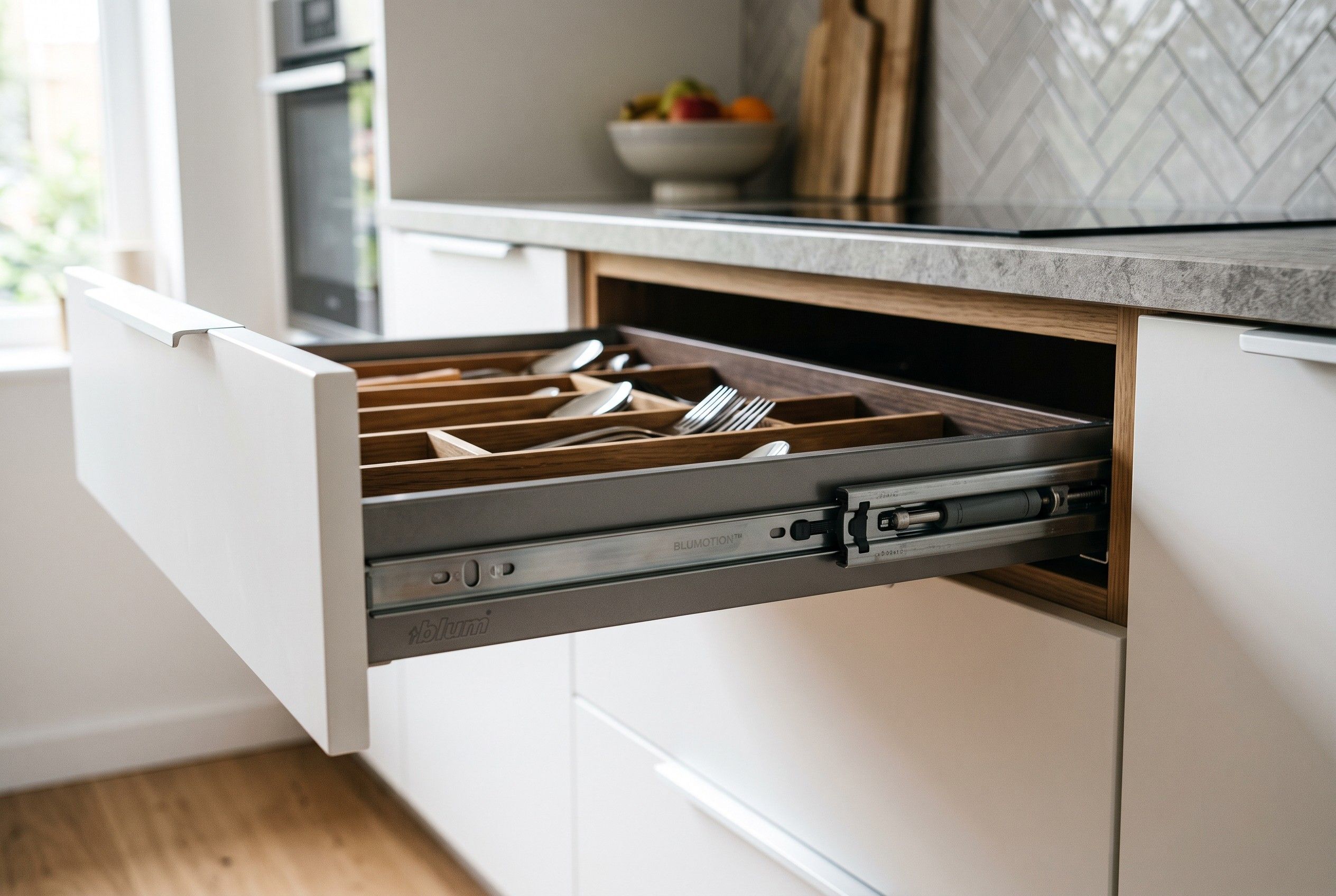
The hardware brand matters where a mechanism works dozens of times a day: a pan drawer, a pull-out larder or a lift system on a wall unit. The gap between a hinge tested to tens or hundreds of thousands of cycles and a cheaper alternative shows after a few years, not straight away. In a cabinet opened once a week, you’ll hardly notice it. We looked at what you pay for when the box says Blum, Hettich or Grass, and where the name makes little difference.
What “hardware” covers
Hardware is the umbrella term for the mechanisms that join and move the parts of a piece of furniture. That includes door hinges, drawer runners, lift systems for wall units, cam connectors for carcasses, and accessories such as pull-out larders and shelves. These parts decide how furniture works day to day, however good the board or the front. A veneered front on weak hinges will start to sag at the corner within a few years, even though the material itself is fine.
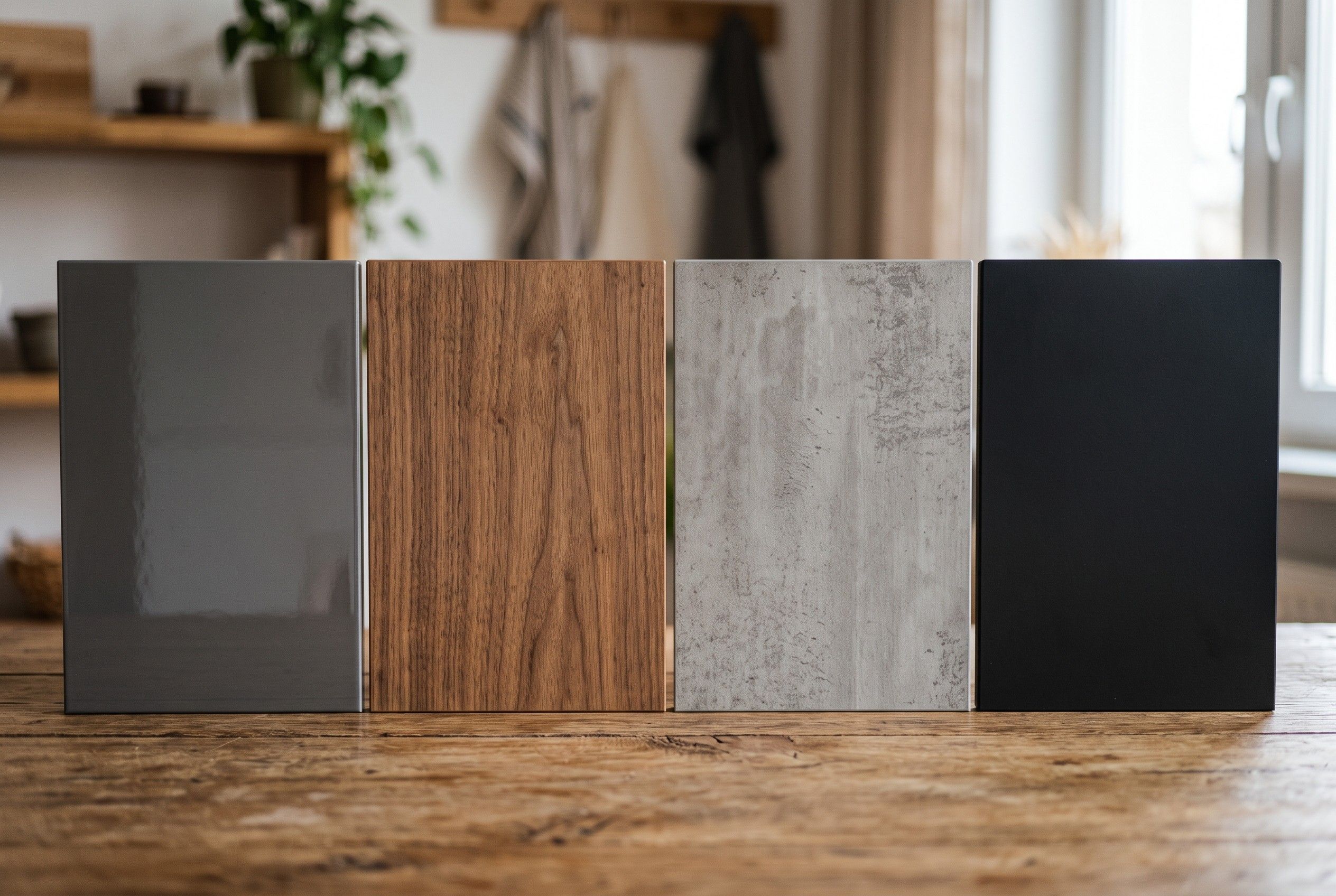
Handleless opening systems belong here too. You press the front lightly and the mechanism pushes it out a few centimetres. They suit smooth, matt fronts, in Fenix NTM for instance, but need a precise mechanism, because that’s what decides how the front responds to touch. The gap between brands is especially noticeable here. A weaker push-to-open mechanism loses sensitivity over time, and the front needs a harder push than at first.
What sets branded hardware apart from cheaper alternatives
The main difference is how many cycles a mechanism survives without losing its smooth action. Premium manufacturers test hinges and runners through repeated opening and closing before they go on sale. Trade sources quote different figures depending on the range and the test method: from 100,000 to as many as 500,000 cycles for premium drawer runners, and around 160,000 to 200,000 cycles for hinges. Cheaper alternatives rarely publish comparable figures, which tells you something too.
The second difference is manufacturing tolerance. Branded hardware is made to tighter tolerances, so doors and drawers close evenly and don’t need adjusting every few months. Soft-close systems, such as Blumotion from Blum or Silent System from Hettich, slow the movement in the last part of closing even if you slam the door. With cheaper alternatives, this varies more from one unit to the next, and the mechanism works loose sooner.
The third difference, less visible day to day, is corrosion resistance. The metal parts of branded hardware have galvanic coatings that resist moisture, which matters near a sink or dishwasher and in bathroom units. A cheaper part without that coating can start to rust in patches after a few years, even if it worked just as smoothly at first.
Blum, Hettich, Grass: three premium brands
Blum is an Austrian manufacturer that gives its hinges, runners and lift systems a lifetime quality guarantee for furniture in domestic use. That’s unusual in the hardware market, where warranties are normally counted in years.
Hettich is a German manufacturer in business since 1888, known among other things for its Sensys hinge range with built-in soft-close. According to trade sources, this range is tested to around 160,000 opening cycles.
Grass is an Austrian manufacturer in the Würth Group, known for its TIOMOS hinges and its Vionaro and Nova Pro Scala drawer systems. It sits in the same class as Blum and Hettich. Detailed cycle-test figures are harder to find in its public material, but that says nothing about quality, only that the company publicises them less.
How to check the hardware when your furniture is delivered
At handover, you don’t have to take it on trust that the hardware named in the contract is really there. Most hinges and runners have the manufacturer’s name stamped or printed on the metal. You’ll see it when you open a door or pull a drawer all the way out. Test a few cabinets at random, too. Doors should close evenly, without a jolt at the end. A fully extended drawer shouldn’t rock from side to side. Noticeable play at full extension means a lower class of runner, whatever brand the contract names.
Where the brand matters, and where it doesn’t
| Location in the furniture | Frequency of use | Worth paying extra for the brand |
|---|---|---|
| Pan drawer, pull-out larder | dozens of times a day | yes, definitely |
| Lift system on a wall unit, above an appliance for instance | several to a dozen or so times a day | yes |
| Cutlery and utensil drawer | several to a dozen or so times a day | yes |
| Door above the fridge, rarely opened | a few times a month | not necessarily |
| Hinge on a cabinet for seasonal clothing | a few times a year | not necessarily |
A pan drawer or pull-out larder works every day, so a weaker mechanism shows within a year or two. A cabinet above the fridge or a high-level wardrobe unit gets opened a few times a month. That puts so little load on the mechanism that even after ten years you’ll hardly see a difference between brands. So choose branded hardware where a mechanism works every day, and cheaper but certified hardware where the load is light.
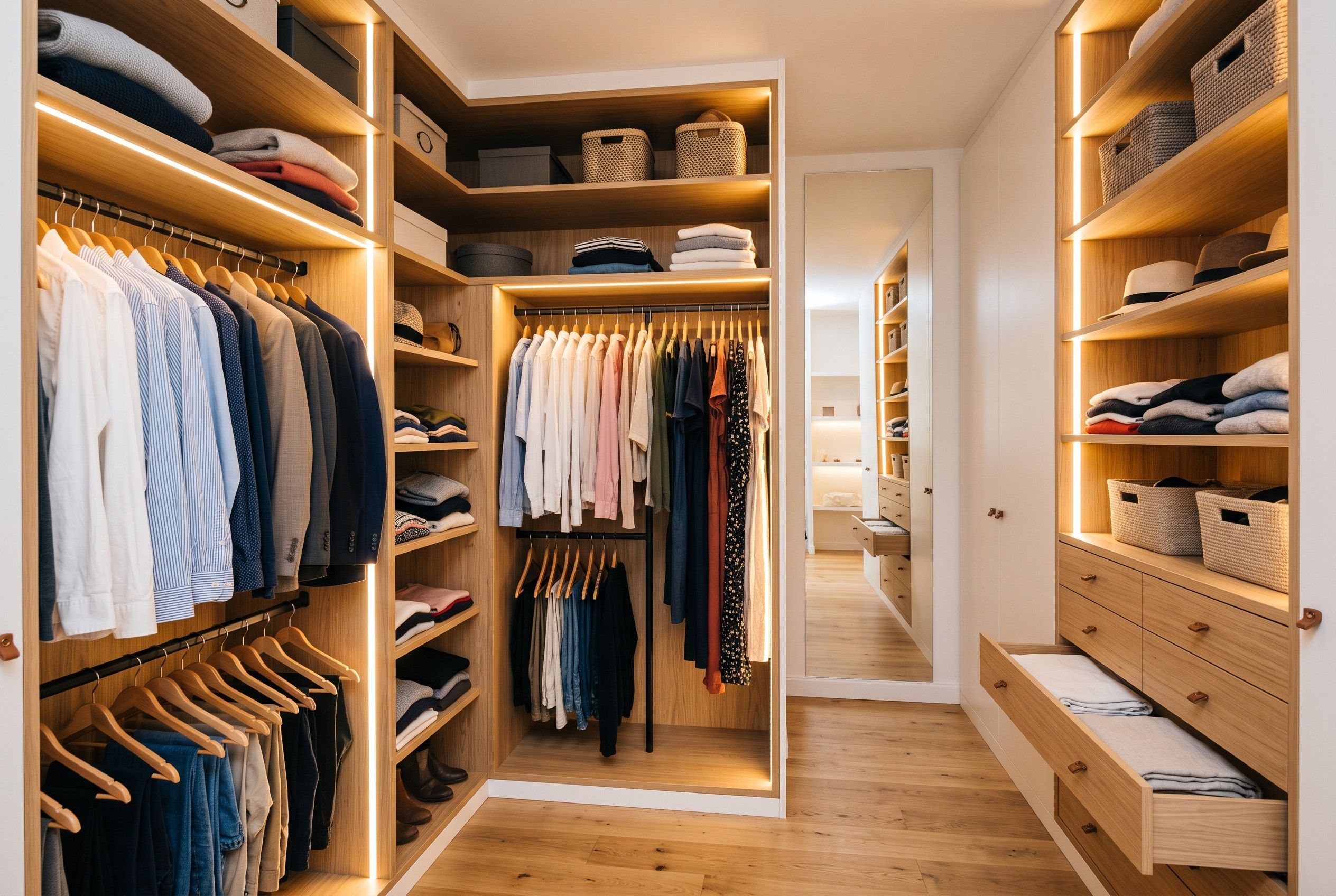
The same applies in a wardrobe, as we explain in the article on planning a walk-in wardrobe. An underwear drawer used every day needs a better runner than a high shelf for suitcases. We look at how hardware choices affect the total cost of a kitchen or wardrobe in the article on made-to-measure furniture prices.
Warranty and spare parts in years to come
Branded hardware has one more advantage that’s easy to forget when you buy: spare parts stay available for many years. If a hinge breaks or a drawer mechanism fails in five or ten years, a large manufacturer is more likely to supply the same model or its direct successor. A smaller brand may have left the market or changed its range by then.
Statutory buyer protection on the furniture lasts at least two years, as we explain in the article on ordering furniture step by step. How furniture copes after years of use, though, depends more on access to parts and service than on the warranty itself.
Before you sign a contract, ask the workshop:
- Which hardware brand and range is included in the price?
- What load rating do the runners have in drawers for heavier items, such as pans?
- Does the front above a built-in appliance have a lift system, and which brand is it?
- Does the price include soft-close on every drawer and door, or only some of them?
- If something fails in a few years, will the workshop replace a single mechanism without replacing the whole cabinet?
If you already have a design and want to check what hardware it specifies, ask through the quote form or when we talk about your kitchen or wardrobe. The workshop has this in the project specification, so it should be able to answer straight away.